Showing posts with label housing. Show all posts

Monday, 9 January 2017

Housing and Health a Link that is broken.

The link between Housing and Health is broken, severely limiting the lives of many our story is just one. 

 Background.

My husband contracted, through no fault of his own, a Staphylococcus infection in his neck in 2007, which crushed his spinal cord, leaving him as a high level (C3-C5) partial tetraplegic. I at the time had a fantastic career as an internationally based engineering project manager, my husband had semi-retired to support me in this. After being airlifted back to the UK, Hubby was placed in a Northern Spinal Injuries Unit. We were both treated so appallingly at this NHS unit we determined that the only way to maximise his recovery was to go private. We used our savings to ensure that he got the Physiotherapy and Occupational Therapy that would maximise his chances of regaining some function. He went from being lucky if he got 2 x 20 minute sessions a week to having 5 sessions a day of different activities. We have since 2009, having used up our savings, transferred his outpatient care to the London NHS Spinal Injuries Unit who have been wonderful.

2009 we secured continuous health care funding for him. I thought this would mean that I would be able to return to work so that we could be masters of our own destiny.

Encountered Difficulties.


    • Standard / Quality of care provided in the community is not safe for someone with complex medical needs.
    • There are insufficient male care workers for disabled men that need intimate care tasks plus need to be physically moved on a regular basis for pressure sore prevention and relief.
    • The NHS like the local councils go for the cheapest they can get away with rather than the best fit for the disabled person. 
    • Our housing is a health and safety nightmare for care agencies to stand a remote chance of giving a decent service. 
    • Often trapped on first floor when very small lift out of service. 
    • Councils totally misunderstand the accessible housing needs of those with severe mobility issues and are placing people in totally unsuitable, unsafe housing. 
    • At National level the British Building regulations for wheelchair standard homes falls way short of the minimum space needs of those that use electric wheelchairs as more and more people do as they age with a disability. For Example, only making allowance for 1.2m turn away space from the end of a bed. Reference BS Part M[4](3b). 
    • The Disability Facilities Grant only allows for pure access issues and fails to legislate and therefore fund needs that are for medical reasons. For Example, extra bathroom for care worker use to prevent cross contamination, extra space for use of physio equipment.

The Result of Deficiencies.

  1. We have only had care provided for 5 months out of the last 84 months (7 years).
  2. Saving the NHS 7yrs x 100hrs/week care provision allocation = [gross cost £20/hr x 100 x 52 x 7] = £728k – care provided = £684k saving.
  3. I have lost more than £420k in potential earning income, my career is in tatters, my future financial security has been lost.
  4. My health as sole carer has suffered and I may well now need care myself in the not distant future due to the tremendous physical strain my body has endured physically lifting my husband in and out of his wheelchair due to the lack of space here and the hours that I need to be “on duty” as his needs 24/7 care.
  5. Hubby due to not having the space to use a tilt table has had more problems with his bowels and many more UTI’s than he could have had. He has lost even more function in his arms and hands that if he had had an accessible environment he would not have probably lost as he could have continued to do some things for himself. He is also very depressed as where he lives it is totally life limiting, isolating, too far away from his family and friends.

Tried to Help Ourselves.

Recognising that we need to first sort our housing situation so that we can fully engage / tackle compiling a care team we have done the following since 2009 without any success.
  • Got ourselves on the council waiting lists Spalding & Peterborough.
  • Contacted local charities and housing associations that specialise in accessible housing.
  • Made local politicians aware of our plight.
  • Looked at the HOLD scheme to see whether we could own our home.
  • Maintained contact with local council funded OT’s.
  • Worked with a not-for-profit organisation who said they would try and help.
  • Held numerous meetings with council officials trying to explain what we need.
  • Wrote and had a paper accepted for the parliamentary investigation into the built environment. October 2016.
Nothing we have done to try and help ourselves has resulted in us getting the help we urgently need.

NHS England could help more.

I note that there have been NHS monies made available for another disadvantaged group, those with learning difficulties which I am glad about as my eldest brother has a severe brain damage condition. May I please beg that those under the continuing health funding also need specialised help as everyone else is ignoring their plight. 
  1. Councils and Housing Associations seem to think their duty to the disabled is being fulfilled with the building of lifetime standard homes.
    • Most of these are totally unsuitable for those with higher mobility needs as it is very expensive to retrofit the extra space that an electric wheelchair user needs.
    • Bathrooms are too small for the specialised shower trolleys / recliner commodes used by those in the higher need category. We have calculated we need a minimum 2.5m x 2.5m footprint.
    • Most accommodation only has one bathroom, which means full shift care-workers have nowhere to change, wash separately after body fluid contamination and vice versa gives less protection to an immune compromised client. Also, means spouses / other family members are often denied the use of a bath.  

    • Most architects assume a double bed in a master bedroom when many require a hospital bed + single bed. This means that a master bedroom must be a minimum 4m x 4m (without storage) to allow for safe manoeuvre space by wheelchair, and safe working areas all around hospital bed by care-workers. The other bed needed by spouse or partner as most people do not get funding for full time coverage and need to make up the deficit in care coverage.

    • Extra care units always assume that people will be semi ambulant this is very clear in the way they always default to an abled-bodied kitchen and bathroom design rather making all accessible by wheelchair. Anything that needs to be retrofitted in our experience never gets done.
  2. Local hospitals are under extreme pressure to transfer patients back out into the community as soon as possible, despite the lack of suitable housing and community care.
  3. Care Homes and Nursing Homes are closing, leaving those with more specialised needs with the unpalatable choice of accepting sub-standard care for their needs or moving long distances away from their support networks.
  4. The national campaigns for the treatment of people with Alzheimer’s have been so successful that they are starting to affect the available options for those that do not have the disease. For example, ask clinicians or community care people regarding the dangers of Autonomic Dysreflexia and you will in most cases be met with a blank stare. 
NHS England therefore needs to keep the pressure up on all the agencies involved to ensure that extra care housing unit commissioners are considering the higher needs of the growing percentage population living longer in the community with complex health and disability challenges. Local Councils / Housing Associations need to be encouraged to work more closely with NHS bodies administrating the population that come under continuing health care. I recently attended a meeting of senior strategic housing people locally where they admitted that they have no idea of the actual housing needs of the people on their waiting lists, and that when people come under NHS CHC they have even less information, because social services are usually at arms length if involved at all.

It would be helpful for NHS England to develop template housing plans that would meet the needs of much of those with complex mobility & health needs; that these are disseminated widely among architects, housing associations, councils, etc. with of course lots of input from the disability community. 

This text has been sent by myself to NHS England so far no response. watch this space. 

Reply was along the lines, Housing is nowt to do with us. Well as long as you have that attitude you will always have people staying in hospital longer than you would like !!


<div align="center"><a href="http://www.carersclub.org" rel="nofollow" title="Carers Club"><img src="http://www.carersclub.org/wp-content/uploads/2016/04/logo@2x-1.png" alt="Carers Club" style="border: none; height: auto; width: 200px;" /></a></div>

Saturday, 26 September 2015

Wheelchair Services

Living on the Edge of Catastrophe.


Many disabled people and their carers will recognise this state, you just about manage every day with your daily challenges, in our case inaccessible housing, inadequate equipment and of course Hubby’s ongoing medical challenges. Then something happens that threatens to tip you over the precipices of not being able to cope.

Last Tuesday we had a fairly successful reassessment of his wheelchair needs, we think the NHS may just about supply a wheelchair that stands half a chance of meeting his needs. Going to have to wait for it to be built though should get it by Christmas. Not totally convinced but will give it a chance.

So I no sooner ask our GP to write a supporting letter, explaining about Hubby’s medical need for a reclining chair because of his various blood pressure issues, pressure sore relief etc. and disaster strikes, his current wheelchair stops inclining & reclining.  This happens at of course 2:30 am Friday, in the morning. So I call the out of hour’s wheelchair telephone number, no answer. Try again at 07:30 and the engineer kindly explains that out of hours is not what I understand as out of hours and what were we doing being up at that time, i.e. 02:30am. He is allowed to sleep you know. Yep he is, but we aren’t.  

I telephone the wheelchair people in Ely, as soon as it gets office hours, try to explain how serious the lack of a fully functioning wheelchair is to Hubby, but get the distinct feeling that I may as well be speaking to a wall. 

Their engineer turns up after 2pm, too late on a Friday afternoon to do anything to help. So he just shows me the nuts that control how far back the chair goes. He knows he can’t leave me with nothing as Hubby cannot be confined to bed when we have no safe evacuation route and Hubby would have to be taken into hospital with the potential effects.

So this has left us trying to cope with the impossible. I will try and explain, I have positioned the nut on the wheelchair so that it mimics Hubby reclining position so that he does not pass out with low BP. So to get him out of bed, I stuff cushions under the wheelchair to tip it upright as much as possible lift him into his chair which then tips back a bit the cushions not being stiff enough, making it near impossible for me to get Hubby postural straight in his chair a problem at the best of times. He then travels down our corridor me watching him like a hawk for things dangling in his wheels, places himself in his safe spot in the front room. I then lodge my shoulder against the back of his chair to lift him and it up to retrieve the cushions so he can recline. When he needs to eat, I lift him and the chair back stuffing the cushions back in place. It is heavy, it is dangerous, one wrong move and he will be out on the floor, he is partially tetraplegic remember. To get him back into bed, stuff the cushions back in, stand on the footplates to keep chair down while I bring him to the front of the chair to lift him across, then lift him quickly hoping the chair propelling back does not hit his feet or me.

What next, start the campaign on Monday to try and get the wheelchair people to order the part urgently, but expect it to come from the continent so it will be a week at least. Cancel Hubby’s hospital appointment for Wednesday where he was supposed to get his picc line removed, he has had a serious infection. We thought about getting an ambulance trolley but then remembered our lift is not big enough to take one and it is potentially dangerous for Hubby to be lying down all day, catheters, eating, drinking, pressure sores, etc. are very difficult in that position. Surprise, surprise, he needs his fully functioning wheelchair to stay safe.


Readers I stand looking out on a potential precipices, this long hard physical week looming ahead, there will be fights with the people that should be helping, there will be a lack of understanding, there will be a lot of I’m alright jack sod you.


Are our wheelchair services fit for purpose?         NO
Is our disability housing fit for purpose?               NO
Is there enough support for our carers?                 NO
Does anyone give a shit?                                       PROBABLY NO.


The Inquiry

Fri 25th Sept - 02:00hrs - wheelchair tilt recline fails.
                      - 02:10hrs- phone Bartrams out of hours - no reply
                      -07:15hrs- phone Bartrams out of hours - Eng says he will convey urgency.
                       -09:00hrs - phone Bartrams main office to explain urgency.
                       -14:00hrs - Bartrams Community man turns up does quick assessment and                                               leaves. 
Weekend      -left to manage with no help what so ever.
Mon 28th Sept- 09:00 hrs phone Bartrams to find out part despite being urgent, only ordered                           on that day, not on Friday. 
Mon                   Cancel wed hospital appointment.
Mon - Wed        try various manual wheelchair options to get Hubby through all unsuitable.
Thursday          told Handicare view their stock take more important that dispatch of the                                  wheelchair part.
Wednesday     declare an adult safeguarding incident to Peterborough Social Services. 
Friday              told you will have to manage.
Monday,          chasing all day again today, no part.


Tuesday, 1 July 2014

Disability Facilities Grant – discriminated against yet again.

Introduction.

Many readers will have followed our struggles to find a wheelchair accessible home in Spalding Lincolnshire. So just to recap, we have tried to help ourselves by:-
  1.  Private rental but nothing out there ready to move into, and landlords will not give you a long enough tenancy to apply for the grants for alterations needed.
  2. We are currently on SHDC s waiting list, but again they do not have suitable properties on their books, and they are about to change the rules so that our local connections will not be local enough anymore. We currently have the maximum points for a medical grounds move.
  3.  We are on numerous housing charities waiting lists, but they do not have properties in Spalding where we want to live.
  4. We spoke with the organisations that report to help the disabled with specialist mortgages, but because I am of working age, likely to return to work, not disabled myself, they will not help us.
  5.  Have tried to educate and make local politicians aware that the system is not working for the poorest, most disabled in society.
  6. We found an organisation, MIVA Partnership that are trying to help us, but once they get this latest news I think they will run for the hills. They proposed buying a place for us to adapt and rent off them long term. Their biggest struggle is getting the necessary finance so that they can make the standard buy to let return ratio of 8%.

Update.
Two weeks ago we thought we had found an ideal property to alter for Hubby’s needs. Just so you know we are not looking at palaces it was at the £120k mark. Our contact told us to start the ball rolling for the Disability Facility Grant as the property would need some substantial alterations to make it suitable for partially tetraplegic (paralysis in all four limbs) Hubby, me and our care team. Our contact in the housing team at SHDC sent a referral for us to the Lincolnshire County Council OT’s based in Lincoln.
Today I had a very depressing conversation with one of the OT’s where it has become very apparent that we do not stand a snow ball in hells chance of getting any financial help, not because we do not qualify but because the procedures in place are so rigid that they discriminate against the most disabled and poorest in society.

Why do I say that ?

1.       I was told , the whole grant procedure can take 5-8 months to release the monies, meanwhile you would have to live in the property.

                        WE can not do that, I would be putting my Hubby in physical danger if I did that. He can not go 5-8 months without having a shower, not being able to gain access via ramps to the property, not being able to access several rooms due to door sizes, etc. Also he is not well enough to live on a building site. I also have to consider the Health and Safety of our care team and myself come to that. Working in confined badly designed spaces is an accident waiting to happen. I am in constant pain at the moment because my back is close to giving out on me, due to all the manual lifting I have to do, in our currently badly designed space.

2.       What private landlord is going wait 5-8 months before he gets his monthly rent ?

NONE ARE.

So it looks like to me , that unless you own your own home, and are therefore not the poorest in society, there is no help for you to ensure that you live in a safe, and accessible home.

In Summary.

CAN SOMEONE PLEASE EXPLAIN TO ME WHAT SEVERELY DISABLED PEOPLE WHO NEED TO RENT ARE SUPPOSED TO DO, as I have run out of ideas?

Most people when we tell them what has happened to us, can not believe that in BRITAIN today we do not look after our most vulnerable, what does that say about the society we live in.


Please RT this, copy it, spread the word, people need to know the present system is not helping the most needy in society.

Wednesday, 29 January 2014

Housing and Care a User’s Perspective.

Introduction

I am writing this to give those working in Housing and Care one users perspective of what is wrong with the current system and why it does not work for us and from what is seen, heard, around us does not work well for others as well.

Background

Back in 2009 my then 64 year old husband qualified for NHS Continuing Care, having been infected in his neck with Staphylococcus Aureus which caused crushing of his spinal cord, leaving him a partial tetraplegic with the added complication of having only one kidney as the right one was removed due to cancer. He has lots of medical complications caused by his spinal cord injury, is very severely physically disabled, cannot walk or stand and has limited arm/ hand function, needs help with all bodily functions, but is very much fully compos mentis.

We had recently returned from working abroad so to get local social services help had rented a totally unsuitable bungalow where Hubby had to be bathed in a paddling pool sat in his commode, stretching the shower hose over him. So when we were moved to the fairly new first floor flat in a development at an extra care facility, we were relieved to have at least a very small wet room.

Very soon after moving in we realised what a huge mistake we had made.

·         The master bedroom is not big enough to take a hospital plus a single bed for me at weekends when I am in charge of Hubby’s night care. Not big enough to allow care workers enough room to safely use a mobile hoist and be able to access the bed all around for using sliding sheets etc.  This has meant that I feel I have been forced to use a very dangerous to me manual lifting regime to get Hubby in and out of his wheelchair / bed. The room is carpeted which is causing difficulties in keeping it hygienically clean, water transfer from wet-room, accidents,  wheelchair tire tracks. The building construction means there is nothing solid to attach either a ceiling or wall track hoist.

·         There is a lack of storage space which means when I sleep in the spare room I have a usable bed which is surrounded and crowded out by stuff that we have nowhere to put. No secure storage for bicycles (my hobby), lack of built in wardrobes and not enough space to be safe in the flat and build some ourselves.
·         The wet room is so small that we have had some accidents when manoeuvring him in his shower chair, painfully catching my fingers, Hubby’s knuckles and toes.  

·         All of the doorways are so narrow that Hubby has to be extremely careful when lining up his chair to get in and out of the two rooms that he uses.

·         Our living room is too small to take a sofa, chairs and Hubby’s wheelchair plus the two side tables he needs so that things are within his reach.

·         All of access in, out and around our flat is very difficult to manage so Hubby is in effect imprisoned in two North facing dark rooms except for the occasional trip out for hospital visits.

·         Only access is via a lift that is so small that in an emergency it will not take an ambulance trolley. Also when we venture out I have to send the lift down and run down the stairs to meet it.
·         Our care workers when here sit at our small dining room table, with no proper storage place for their files and paperwork.

·         One luxury we have is a second bathroom which gives our care workers a separate hygiene area, and somewhere to store the hoist that they have to use. Not really a luxury as our home is their place of work, we don’t want to share a toilet with them. Accidents happen as well and they need some where to shower and change. It also means that I get to soak my over worked family carer aching bones in a hot bath now and then.

·         Our kitchen is totally inaccessible to Hubby.

·         A couple of years ago our housing association thought it a good idea to take away the wooden threshold strips leaving a 1 ½ inch gap under the door which then sucks into our flat the second hand cigarette smoke of our neighbour. Not an ideal living arrangement for a tetraplegic who is on the very limits of being able to breathe unaided. Also she is an added fire risk that with limited evacuations options is not acceptable to us.
Since writing this in January, our next door neighbour set her flat on fire, sadly losing her life. Despite what was reported in the local paper we did not have a safe exit option, we were trapped in our flat while they put the fire out. There was dense smoke blocking our only exit from the flat. It is even more urgent that we are moved to some where that is safe.


Needless to say we are both totally fed up with living somewhere that is totally unsuitable, is not enhancing what little life Hubby has left, and putting me as his carer at physical risk.

The Challenges

So what have we done to try and remedy the situation?  Three years ago we met with a council OT, who agreed that in principle we were housed in the wrong environment, were awarded the maximum points for a medically based move. Looking back on the interview, with the hindsight of doing more research, I now realise, from the way we were spoken to, that we were being condescended, that our concerns were not being listened to, but being replaced with pre-conceived notions of where disabled older people should live.
Since being on the housing list we have met with the obvious attitude that “you should be grateful for a roof over your head”. People in general do not recognise that disabled people should have the same choices as everyone else as to where and what kind of place they want to live in. This is obvious with the few places that we have been given the option of looking at. OAP bungalows with even less space, houses with tiny internal wheelchair lifts that Hubby cannot operate safely etc. It is becoming very obvious to me that no one has thought to build or adapt existing bungalows to meet the growing need for disabled wheelchair users that maintain their independence in the community by making use of care teams. Local Authority teams do not recognise the different space requirements of totally independent wheelchair users and those that need a care team.

The other day I looked at the floor plans for a new over 55 development in Bourne Lincolnshire. Not one of the floor plans had a bedroom big enough to accommodate 2 single beds plus wheelchair manoeuvre room or a separate hygiene area for care workers. Everyone seems to think the elderly and disabled want to live on a postage stamp.

So having increasingly despaired with the social housing market I turn my sights to private rentals. We would have to contribute more to our rent as the housing benefit allowances for private are not as generous, but as I fully intend to return to work as soon as possible this is not a big issue if we can get a landlord to work with us to make a bungalow accessible. We came across somewhere that we could have made perfect for our circumstances, it needs some alterations for has lots of potential. We got past the first hurdle of the rental agencies that usually suddenly make the property unavailable to disabled enquirers, got to speak to the landlord to explain our situation. He seemed very understanding of our plight, I explained that we would need to change the on suite bathroom into a wet-room out of our meagre savings, then once moved in apply for a disability grant for the other changes that we needed.  Also that longer term if my work situation panned out we would look to buy it off him. I also explained that we would need some sort of secured tenancy as to apply for the grant the council want to know you can live in the property for five years. Anyway we left the conversation at that point, as we had to involve the estate agent he was using to manage the rental. So I talked it through with the agent explaining the different type of rental agreement we would need, as she had no experience of other types other than the short-hold, 6 month, 12 month assured tenancies more usual in the private rental market. The estate agent and landlord subsequently had a conversation and unfortunately the landlord was not in a position to grant us a 5 years short hold or an assured tenancy so our perfect property fell through.

This means that in most cases the private rental sector is totally unavailable to mobility restricted renters, but the local authorities / social housing associations are not providing it either, does not sound very equitable or fair to me, or looking after our most vulnerable in society, does it you?

Still we have not given up, we found a company that sounded promising at first. They said they would find an investor to buy somewhere for us, for us to rent from them. This company so far has failed to find such an investor to help us.

Then I heard about a scheme for part ownership / part rent shared ownership scheme especially for disabled people on benefits. Guess what no help there because Hubby is over 65 and because I hope to return to work.

A Way Forward.

With the pooling together of Health and Social Care I am hoping that local authorities will feel more obligated to get housing right for those that have care teams. There needs to be recognition amongst all involved that health does suffer if housing is not right. Not just the disabled person as well, but family carers and the risks in the work place for paid care workers.

More people are having care provided at home, not just the short visit kind, but up to 24 hour coverage, which enables them to stay out of care / nursing homes. Suitable housing must be made available for this group.

Space for a wheelchair user is not a luxury it is a basic health and safety requirement.

Social Housing Providers need to do the following :-

1.       Make those needing specially adapted properties a priority as this group has very little choice to go elsewhere.
2.       Study in close detail, and case manage the disabled / older persons on their housing lists.
3.       You may not have the right housing stock. Think outside of the box where necessary to provide solutions either through new build or the adaptation of existing open market available properties.
4.       Listen carefully to the disabled as to what they need to get by, they are the experts on what it takes to get them through on a daily basis.
5.       Make sure properties are not in socially isolated areas, disabled want the same location choices as everyone else in society.
6.       Remember it will be a home but also in many cases a place of work for care workers.
7.       Stop putting wheelchair bound users on anything but the ground floor, it is not safe, even with lifts available , if cannot walk down/upstairs.  Increases evacuation time, can get stranded outside home if lift out of order. Puts unfair onus on care workers and fire department to evacuate person.

We will keep fighting on to get suitable housing for ourselves, not what someone else thinks is suitable but what we know will work well for us.


Angela 

Sunday, 3 November 2013

What could #Peterborough do better to be more #Disability inclusive ?

What could the City of Peterborough do better to improve the quality of life for it’s Disabled citizens.

Following a Twitter conversation I was given the challenge to put into words my thoughts on what would make Disabled people’s lives in Peterborough a bit easier. I can only write from the perspective of what I know, so I apologise straight away to those that have disabilities that I only have limited knowledge of such as sight, deafness, mental illness, learning difficulties. I will leave it to experts in those fields to write an equivalent essay on what would help these groups.
A bit about my background. I am the full time carer of my husband who survived a high level spinal infection that left him as a partial tetraplegic. (Paralyses of all four limbs). I also have some knowledge of what is called Learning Disabled these days as my eldest brother lives with severe brain damage caused by a TB/Meningitis as a child, also my aging mother has reoccurring mental health problems and some mobility restrictions. When I worked, I was a professionally qualified manager having gained an MBA and worked in engineering in various safety (NEBOSH qualified ) and project management roles.  
So my paper will mainly cover the difficulties encountered by those that use a wheelchair to get about. It will cover the following areas, Out and About, Access to Leisure Facilities, Access to Medical Facilities, Housing, and finally City Planning.  

Out and About.
Living with and accompanying a wheelchair user out and about really opens your eyes as to how inaccessible many areas of life are still to this group.  Even when you go out solo you find yourself asking the question, if husband was with me how would we manage in this situation or that. We live near the Serpentine shopping centre, where we often walk/roll to in the good weather to do a bit of shopping or just to get away from our intolerable living conditions to have a coffee. The first obstacle for us is the extremely small lift that is the access point from where we live. Husband can not safely use the lift solo so I squeeze in beside him so that I can press the buttons for him. Coming out of the lift we often see many other disabled people having meals “at” the food court tables.  I have put “At” in inverted commas as many can not sit properly at some of the provided tables because they are not at a good wheelchair height and have design obstacles that do not accommodate their footplates. Most of the stores are accessible in access terms for wheelchair users, well until it comes to sale time, when the pile it up high and wide fever takes over and restricts access to many aisles.  Biggest bug bear with stores is those such as W.H.Smiths that regularly narrow down walkways with temporary sales stands and exhibits. Recently I was also shocked to find out that Tesco’s had not considered the needs of the wheelchair user when putting in its opticians, they can not accommodate the optical testing of people in wheelchairs. Again who signed that off as Equality Act compliant? May be that is the problem no one is checking for compliance. On a good note, Costa Coffee has removed a rail that ran the length of their counter making access for wheelchairs a lot easier. Having a cup of coffee is not easy as well, as many cups supplied are impossible for those that have weak hands to hold. Many weak fingered like to wrap their hands around the vessel putting their fingers through the handles for extra security. Many designs make this impossible either because the handles are too small or the cup gets too hot to handle. We always use a take-out insulated cup instead with the lid as it is safer. We have only been challenged once for doing this as some cafes differentiate between drink in and take out. The other general thing that people who design shops always seem to never take into account is the height of their counters, nothing worse for an independent chair user not to be able to reach the menus / information / cash payment machines that is available to everyone else. I recently went to Dominos in Hampton Village centre and it had the worst counter height I had ever seen, it was high for anyone under 5ft high. Also I noted that the doors were very difficult for a wheelchair user to open.

Toilets for the wheelchair user can also be a nightmare especially if you rely on someone to help you. Cubicles are often too small to accommodate wheelchair plus carer, even though they probably conform with all the statutory building regulations. We also find difficulties with many of the tiny sink types supplied and end up making use of wet wipes. Also no one seems to have thought about where do you put used urine medical devices that quite a lot of wheelchair users use to urinate. Many sanitary deposal bins say female tampons/pads only.  Just to note as well, many wheelchair users have also written about the inaccessibility of the new Dyson blade hand dryers.

Smaller premises in surrounding villages / suburbs of Peterborough such as small hairdressers and other independent retailers must start to think about providing ramps for wheelchair users to access their premises especially where they have a stepped entrance. Also information displayed outside saying what accommodations they have for chair users, i.e. I will come out to you, provide a ramp, etc.
Finally a Question, when at Peterborough Rail Station last, I asked myself, how would an independent wheelchair user get from the station to the rest of town. I think I came to the conclusion that it would be via a taxi or by a very long detour to find a safe place to cross the dual carriageway. The bridge is not accessible, only has a lift on one end. Hope they address this issue during the refurbishment of the station.

Lessons to learn:
  1.  Do not allow the signing off of lift sizes that will not accommodate a wheelchair user + carer. Also will it take an Ambulance trolley for medical emergencies?
  2. Restaurateurs / Café owners can a wheelchair user sit comfortably at your tables, rather than having to have food on laps or sitting sideways on?  You supply high chairs for babies so why not an adjustable height table for wheelchair users?
  3.  Shops do you have a counter height that someone in a wheelchair can access.
  4. There needs to be some people employed by the city of Peterborough to check new business premises have complied with accessibility requirements, working with them at the project planning through to completion stages and also help established businesses do better.
  5. Every store should do a trial run with store staff being placed in a wheelchair to see what the store looks and feels like from a wheelchair.
  6. Toilets need to have a medical grade waste bins and again someone needs to test run facilities actually sat in a wheelchair, asking questions as can I actually use the sink, can I easily get in and out , can I transfer safely from chair to toilet and back. I am also disgusted with the notion that some advocate sitting on the toilet and the sink being in reach to use while being sat on the toilet. Hygiene?

Access to Leisure Facilities.

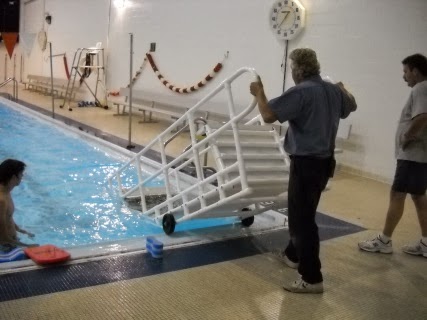
Many of us marvelled at the achievements of the paralympians, their dedication and commitment to train and overcome their various limitations. Unfortunately just like the rest of the general public, people that are disabled come in all shapes and sizes. Many would benefit from being able to do some physical activity but are prevented from doing so because leisure facilities supplied in Peterborough, new and old do not make the bit of effort it would require to include everyone and make all welcome. My biggest complaint are the various swimming pools in the area including the hydrotherapy pool at St Georges, have failed to realise that not all disabled people can safely use a hoist or lift chair. If you have a disability that causes,sudden spasms, have limited use of your arms, weak trunk you should not be using such a device as there is a real risk of you falling, slipping causing injury. Instead you should be transferred into a lightweight pool chair and be ramped into a pool, then floated off the chair with the help of a carer. This would also benefit people who walk badly that find steps difficult, probably people with sight issues would also find this type of access easier. I know it would be very unsafe to try and put my severely brain damaged brother in a hoist as he would not sit still, scream the place down, he loves the water, but as he has got older his mobility has worsened meaning that he finds steps very difficult. Swimming / water therapy for mobility restricted people should be prescribed on a regular basis the long term health benefits are well documented but largely ignored by community services up and down the country including Peterborough. Gyms also fail to cater for wheelchair users that want to build up their upper body strength, putting in pieces of kit that can only be accessed via an inbuilt seat, rather than a removal one. They could also provide Velcro straps and other aids that would make lifting small weights safe for the disabled.

People who organise festivals and special events. Some expect all wheelchair users to be able to park on rough / sloped / gravel / grassed ground and still be able to decamp from their wheelchair accessible cars and traverse to the event. It even happened at the mobility show a couple a years ago when we went. Not everyone is a Paralympian and do not have the strength to do that.

Cinemas that insist on wheelchair users sitting at the front. No good for my husband with all the metal work in his neck he can not lift his head that far for that long.

There are still a lot of barriers to going out in a wheelchair, that as an able bodied person you would not necessarily think about.

Lessons to learn:
  1.        Pools should invest in removable ramps and light weight pool chairs.
  2.        Gyms to make as many pieces of equipment as possible accessible.
  3.     People that organise events should road test their facilities via a wheelchair.
  4.    Cinema owners should take out some seats at the end of some rows to accommodate wheelchair users at various sitting positions in the cinema.

Access to Medical facilities.

Most Doctors surgeries in Peterborough are for the most part accessible. Many do not have a hoist available for couch examinations. Many consulting rooms are very small with inadequate door widths for comfortable access. Waiting rooms sometimes fail to make safe waiting areas available for wheelchair users, too many standard chairs in the way. Also for those that can walk with difficulty, no higher seats to make getting in and out of easier.

Dentists & Opticians are for the most part inaccessible to visit. Even if you can get through the door, the consulting rooms are full of immovable equipment which make it impossible for the wheelchair user, unless can walk a little.

Hospitals in Peterborough are pretty accessible as they are generally built to take hospital beds in corridors etc. Many mistakes were made at PCH, some of which have been resolved as building work has been completed. Still there are very long corridors in PCH with quite a few inaccessible doors that create barriers to the wheelchair user. Using diagnostic machines for x-rays etc is still an absolute nightmare for the mobility impaired. The equipment being used is just not transfer friendly.   

NHS Wheelchair services were transferred out to a company in Essex. This has been an utter disaster from where we are sitting. They have such a huge area they can not possibly get to know their clients. They seem to be utterly thrown by clients that have the top level of specialised need. We have been trying to get a loan chair for over three months now that I dare sit Husband in for any length of time so that his oh so essential chair can be repaired. We have had drivers turn up without any tools, without head rest, leg raisers, chair recliner etc. Next visit will be the fifth attempt at getting it right so that we can get husbands chair fixed of his horrible noisy recline mechanism which sounds like it is going to fail at any moment. The cost of the petrol alone must be horrendous.

Private Physiotherapists in Peterborough generally do not cater for people in wheelchairs, some will do home visits. But at their premises no hoists. We used to go to a business run out of a house that had recently gone through planning permission that no one had said to them what about accessible access? We shamed them into buying a temporary ramp so that we could get inside through the high stepped door that is typical of domestic house builds. Inside all of the physios we visited no hoists or wider couches which the disabled usually need. Another just around the corner from us is in a relatively new business park, where there is no disability designated parking and the entrance door is impossible for an independent wheelchair user to use.

Lessons to learn:
1.       All of these businesses whether private or NHS need to do the wheelchair test.
2.       Someone at the council needs to enforce accessibility at the planning stage, for both refurbishments and new builds.
3.       Peterborough NHS needs to take back its wheelchair service.

Access to Housing.

Unfortunately people who are unable to walk and totally reliant on a wheelchair will find there are many barriers to finding somewhere to live. If you are lucky and your incapacity comes when you own your own home, you will be able to apply for a disability grant to help with making modifications to your home as long as you don’t have over the prescribed limit in savings & income.

For those without their own homes that rent to provide a roof over their heads you will encounter several difficulties. Private landlords unwilling to provide secured tenancies, and local councils / social landlords that will not take into account your particular needs. You will be left with choices all extremely unpalatable and in varying degrees unworkable.  

Social Housing. You apply to join the local waiting Iist and if you have a medical need will be assessed by a housing OT. This is where it seems to go wrong, as the remit of the OTs seems to be to try and under remit your disability as much as possible so that they can make you look like you are being overly fussy about where you live. You will encounter phraseology such as, “of course you will need to consider ground floor flats” , “you know we do not have many bungalows in our stock”, etc etc. The approach is not to document what you actually need but how much they think they can get away with. This has led to me seeing disabled people all around me in places that I know they, family and their care workers must be struggling in. The council does not seem to grasp the difference between someone that needs level 2 housing and level 3 wheelchair accessible housing. Also that within level 3 there is two further categories, firstly the independent wheelchair user that is either living solo or with family and secondly the dependant wheelchair user where the home is also a place of work for care-workers. The latter needing the greater “out of the box” thinking as standard wheelchair home will not necessarily work because of the possible extra hygiene and medical requirements. Peterborough like many councils up and down the UK is badly letting down it most vulnerable in this respect.

Private Renting. If you are a dependant wheelchair user you will be extremely lucky to find a private landlord that is willing to give you a secure tenancy of five years plus so that you can apply for a disability grant to make the changes you will need to make a safe accessible home.  It is about time there was a requirement of multiple property landlords that have 10+ properties to make the 1 in every 10 accessible to a wheelchair user.

New Builds. Planning departments should insist that large new developments include an appropriate mix of all building types.

Extra Care / Care Homes / Nursing Homes. Much has been said in the press lately about the problems people face with dementia. A horrible disease that took my maternal grandmother many years ago. I have become increasing worried lately for our older folk and disabled that do not have this disease as their liberties are being taken away in the institutions above in the name of keeping those with that disease safe. These institutions should be very wary of this, it is very difficult to accommodate the very varied needs of those in these housing options. I have also become increasingly aware that families are putting their loved ones in extra care facilities because of the degree of independent supported living it gives as a more socially palatable solution as opposed to the guilt of putting loved ones in a care home and all the negative associations that has. Even when this is not suitable because of advancing dementia, lack of facilities to cater for complex medical problems and from where I am sitting local councils are duplicitous in this. Every area needs to have a mix of different facilities that cater for the different difficulties people find in later life or when disability is involved. I personally do not think Peterborough has got this balance right at present. People are being put in places according to next on the list, emergency placements etc instead of what is right for them and their condition.

Lessons to learn:
  1.       Someone at the council needs to head up a task force with social services and NHS continuing care people, looking at who is on the housing list with what medical / disability needs. Then a plan needs to be put in place as to what measures can be taken in conjunction with those citizens to house them according to need and not what the council can get away with. This would include the acquisition of a small amount of privately owned bungalows to refurbish, new builds and existing Housing Association properties.
  2.       Someone needs to deter families from putting disabled & elderly relatives inappropriately in extra care facilities. Checks need to be made prior to move regarding accessibility, hoist availability, specialised care worker availability.
  3.       OTs at the council need more training in the difference between someone needing independent level 3 wheelchair accessible housing and those that need specialised dependant housing to house care-workers as well as tenants.
  4.        Private landlords need to be engaged to try and persuade a number of them to cater for wheelchair applicants.


City Planners:

If I were to write a school report about accessible planning in the City of Peterborough it would say “could do better”. In all aspects of planning questions should be asked as to how does my decision affect a wheelchair user? can a wheelchair user access this business ? will this pavement surface I am signing off be comfortable for a chair user to traverse? Should this business owner being doing more to make this planning application more disability friendly ? Has the business done the wheelchair access test ? Should this lift be big enough to accommodate an ambulance trolley ? Can a wheelchair user get out to a position of safety quickly and easily ? should this buildings ceiling be capable of taking a ceiling hoist ? Is this public access room big enough to accommodate a person in a wheelchair? Should this new small business be allowed to have their business upstairs with no access? Etc etc….


So there you have it some of the things Peterborough could do better to make Peterborough a more inclusive city. 

Saturday, 5 October 2013

Housing Standards Review - My thoughts

Dear Committee,

I hope you will accept my open letter regarding standards in housing as much of your form does not give me the chance as a carer of a severely mobility restricted disabled person the chance to tell you what accessibility  means to us at the sharp end .

Scope:
My comments are directed towards the housing standards for a person confined to a wheelchair and what they require to live safely.

What is wrong with the current system.
The current system of building accessible housing fails to prescribe workable measurements to give builders the information they need to make sensible decisions on the practicalities of living from a wheelchair. For example it is no good to prescribe a minimum size for a disabled persons bedroom space, unless the maximum possible needed space is taken as the standard, for example a single disabled wheelchair user using an ordinary bed who can transfer independently  has different space needs to a couple , one of which needs a hospital bed with all round access + a further single bed all to be housed in that room plus hoist plus medical equipment . People seem to not understand that unfortunately many couples with one disabled cannot share the same double bed.

There are also some regulations that are not working and I have seen regularly ignored with good reason, for example the maximum distance from a toilet to a wash basin, these anomalies need to be found in the existing legislation and be removed. In that example the existing regulation seems to be advocating that someone sit on the toilet and wash their hands at the same time, which is a hygiene no-no and encourages the dangerous use of the wash basin to aid standing up from the toilet.

There are also lots of things that the current legislation does not prescribe and because of that are not included in the building standard for disability housing. I recently visited a so called 2 bed purpose built wheelchair standard bungalow which we turned down as totally unworkable for us on the following grounds, the open plan living/kitchen/dining area was so small that it did not have sufficient room for furniture for the abled bodied in the family to sit on plus manoeuvre room for the wheelchair user , dining table , decent sized fridge freezer or anything a kin to modern living. Storage space in the place was totally inadequate. The master bedroom was too small to accommodate hospital bed plus further single bed. The garden was extremely small with no shelter and no privacy. The wet room was huge but it was expected that everyone using / living in the house would use that one bathroom, totally unhygienic and would leave my immune compromised husband open to cross infection from his care workers. There was no where to put the care-workers and their paperwork , equipment etc. The person who designed/ built the property has obviously never had to share their living space with the average offering of care workers. All of the door thresholds were supposed to be level but had fittings put on them that caused a “bump” to a wheelchair user. All of the doors were slightly wider but had standard handles making them impossible for a wheelchair user without upper body strength to use, no use of sliding doors which are easier to operate and save on space. There was an absence of modern technology that could have been utilised to make it easier for a disabled person, no electronic front door opening but keys that someone with hand weakness cannot use. The house had carpets as well fitted which are a total no-no to most wheelchair bound people. The bungalow had been built in an isolated estate too far away from the local amenities for the user to access without major investment in taxis or mobility vehicle.

Where we live now we access our totally unsuitable first floor flat via a lift that is so small it is not big enough to fit an ambulance trolley in, that does not have a manual way to work it when the lift is out of order or locked out during an alarm activation. Also no mirror at foot level so that a wheelchair user can see when his feet are getting too close to the wall. Our local shopping centre also has a lift that is too small. Building regulations should have been in place to stop these from being built that way. My point being what we have now is not prescriptive enough so having less detail will make the situation worse.

The decision your committee makes will have real life effects.
Imagine if you will, the situation my husband finds himself in. Every morning your wife gets you up from your bed, physically lifts you into your electric wheelchair (not enough room to use a hoist), that has been carefully squeezed in between the two single beds. You reverse very carefully as even misjudging it by a fraction means banging into the wall behind you, causing pain to go right through the metal work in your neck down your already damaged spine. Making sure you have folded in your power controller you carefully shoot for the centre of 75cm width door so that knuckles do not get banged, then turn as sharply as you can so as to not bang into hallway wall, traverse down the hallway that always has the light on because it is so dark. The door to the living room is a little wider so a bit easier to turn right into. Drive up to the TV and use it as a mirror to reverse into your spot in between the other furniture in the room where you will stay most of day, day in day out. Your wife brings you a bowl of water for a wash because your wet-room does not have an accessible sink. On shower days you are put in your wheeled shower chair and very carefully showered in your tiny wet room , where you regularly bang your feet and hands on the toilet furniture because it isn’t big enough. You are then nearly thrown out of the chair as your carer pushes you across  from vinyl to bedroom carpet. Then resting in your hospital bed afterwards are assaulted by the stench coming from the bathroom that never dries out properly due to bad drainage and ventilation. So, Bedroom – wet room- living room that’s your world as you cannot use the inaccessible kitchen or dining area which is used by your care staff as an office. Going out is very difficult because of all the barriers to freedom of movement. So there you sit in a room with insufficient day light, wondering why you are still alive and what’s the point.

If the builders get it wrong it will affect the quality and health of our disabled who have enough to challenge them in everyday life as it is.  

So the nub of my comment is if you do not prescribe to a builder / designer what is acceptable and workable in the way of space & other requirements for a wheelchair user , they will not ordinarily understand not being in that situation themselves and opt for what they know best, cram as much in to maximise profit per square metre.


I hope you will accept my comments as a lay person living with someone with a severe mobility disability. 

Thursday, 15 August 2013

Commission on Residential Care - call for evidence

Dear readers for what it is worth, here are my thoughts,

Introduction.

I write this paper as the carer of a complex spinally injured Tetraplegic husband, the sister of a severely affected learning disabled adult, and the daughter of an adult with reoccurring, severe, complex mental health episodes.

Firstly to answer the specific questions posed by the commission.

The Questions.

1.       How do you define residential care?
Residential care to me is the care provided in registered care homes, nursing homes, and hospices. These places are supposed to provide round the clock appropriate support for their residents and should provide a safe and comfortable place for those that need extra support that in their particular cases living in the community could not give.
a.       Do you see extra care, retirement villages and other “housing with care” options as different by definition?
Yes, they should be but it is becoming apparent to me that because of the stigma of putting loved ones in care homes, many family members are inappropriately putting their relatives into places like this and then wondering why there are problems and sudden deteriorations in health.
b.      What makes them different?
These extra care facilities and retirement villages should be for people that need minimal care and help for daily living tasks. They should be for people that like to be part of a community feeling but still want a high degree of independence. Excellent for people who live on their own to combat loneliness, make them feel safer as people they can call on if needed. Have replaced the old warden controlled bungalows in many areas. They are totally unsuitable for people with late on set dementia, or others that need round the clock support to stay safe. The latter, because they are not usually big enough dwellings to accommodate full time care worker teams or the medical equipment that comes with complex medical conditions.

2.       What outcomes do people value when it comes to care and support?
Firstly that whatever environment a person lives in it supports them to live life to their fullest potential. That it gives the person as much choice as they can handle. Examples of, that they can choose, if appropriate to their condition, when to go to bed, get up, eat, what to wear, who to associate / socialise with, what hobbies to pursue. That the care and support provided is delivered by people trained appropriately to their need. For example people with dementia have access to specialist care-workers to help them through the different stages of the illness, people with learning difficulties have care staff that appreciate the need to constantly re enforce learning, people with a physical disability have care workers that understand the processes of SCI / MS/ MD / spina bifida / arthritis /blindness / deafness etc.

3.       Can existing residential care deliver these outcomes?
Residential care in its current form has the general reputation that the Victorian workhouses had of the past. That of somewhere no one wants to end their final days in. I believe that things will have to change or people of the next generations given a choice will refuse to use them, which cannot be a sustainable business model for the future. People’s expectations of living standards have and will continue to change. Where in the past it was quite acceptable to live in a bed sitting room arrangement with a shared bathroom / dining facilities, many would find this arrangement if fully compos mentis totally abhorrent today.  Residential care is also being used to paper over the cracks of the shortage of wheelchair accessible homes, this abuse needs to stop. Many generations now find communal living an anathema , people value their personal space, so the thought of communal sing-a-longs, being forced to associate with people they do not know, eat and live with strangers can be very frightening. The generations to come will value technology, [that technology use has changed the way we socially interact] like doing things many times on their own, will be more orientated towards their own inner circle of family and friends.
One other thing to note is that people are becoming more and more, savvy regarding medical knowledge and will not accept the poor standards of training and knowledge currently prevalent in the care sector.
So in short I believe the current model is unsustainable and will not deliver the expectations of next generations that end up needing to use such facilities.

4.       Is there a difference between good residential care and other forms of good care, if so what makes it different?
Good care where ever it is delivered should be appropriate to the individual needing that care. The persons delivering the care must be appropriately trained. The best examples of good quality care are that which is delivered by family carers because they usually actually care about the outcomes of the cared for, somehow paid care-worker companies need to “bottle this” and replicate this among their workforces. Hospices seem to also have a generally good reputation, but since their clients usually have a poor prognosis this may be the reason, or it might be because they tend to be staffed with competent specialist nursing staff.
Good care is a person centred approach that recognises that we are all different with various aspirations. That provides appropriately trained staff, that are adequately supervised. That has measures such a password protected remote web viewing so that family can see what is going on in the facility at any time as a reassurance.  Care provision that fulfils an individual’s hierarchy of needs as defined by Maslow, basic needs (e.g. physiological, safety, love, and esteem) and sometimes growth needs (self-actualization) as well or as Carl Rogers would have it that humans have one basic motive, that is the tendency to self-actualize, to fulfil one's potential and achieve the highest level of 'human-being-ness' they can.
Residential homes that provide services that actually do more than just house and feed their clients have to been seen as providing good care.

5.       How will the role of residential care change in the future?
There will always be a need for establishments that provide care that would be provided in a hospital setting if they did not exist. I cannot see how residential care can change in being anything but the place of last resort for most groups that would need to use their facilities.
It is my view that residential care should only be used in the following circumstances,
·         Where the individual’s current living arrangements would mean them coming to significant harm due to a mental incapacity.
·         Where an individual actually wants to live in a communal setting and a retirement village / extra care facility is not appropriate.
·         Where specialised end of life care is needed.
·         Where specialised respite care is needed and only if not possible to be done in own home.
Since it is the home setting of last resort in most cases, it should be made as painless a procedure as humanly possible. People should be able to have their personal possessions, some personal space, access to technology such as Satellite/Cable TV, internet, phones etc. Personal bedrooms, bathrooms, sitting space. Should be more like a high class residential hotel. In the future I can see the need for these places to have unique selling points, such as hydrotherapy pools, access to physiotherapy, specialised OT sessions etc. to make them more palatable.

6)      What future role would you like to see for residential care?
i)        #1 priority where ever possible and if the individual wants it, care should be provided in a persons’ own home.
ii)       More action needs to be taken by the government to ensure there are adequate wheelchair accessible homes available for people in the community to rent and that disability grants for people to adapt their existing homes are still supported and adequately funded.
iii)     That there is a national set of training standards and qualifications for care workers.
iv)     That care workers are considered in the same line of promotion as hospital health assistants and nursing staff, and come under the auspicious of the Royal College of Nursing in the setting of standards and codes of conduct.
v)      A national framework is developed as to the necessary levels and standards of staffing needed to look after the various conditions supported in a residential care / nursing home.
vi)     That someone is made responsible for taking an overview role of the types of care available in residential care homes large and small ensuring that they meet the spread of need in each geographical area. For example make it unacceptable for immediate
family to have to travel great distances to keep up a relationship with their LD kin.
vii)   A designated person is made responsible for ensuring that extra care and retirement villages do not house people that are inappropriate to their level of expertise.
viii)  That fire departments are stricter on the requirements for safe evacuation from shared premises housing people with particular needs, whether they be extra care facilities, retirement villages, care homes, or nursing homes.
ix)     That council planners ensure that mobility restricted individuals are not housed in buildings where they cannot be easily evacuated quickly from in an emergency. Should be a maximum time limit for evacuation like an aircraft. That building owners conform to ‘excellent’ standards of maintenance, heating, ventilation, noise control, rubbish storage and collection. 
I still firmly believe that moving into residential care will always be seen as the course of last resort for many. If the sector were developed carefully, taking into account the aspirations of the new generations, and so that no one that did not really need to be in such an establishment had choices of where to live, more people would be better accepting of the time when they became too ill / dependent to live on their own.

In summary.

Let me use my knowledge of my own family to ponder the alternatives they currently have as an example of how things have to change.

1)      My Severely Learning Disabled Brother.
My 47 year old brother has the mental capacity of a limited 2 year old having contracted TB Meningitis and epilepsy as a baby.  He lives over 60 miles away from his family in a small residential home.  The staff to care ratio is higher than some establishments, I believe it is 1 carer to 2 residents. The distance from family has severely limited the contact of family and made it impossible for me to maintain reasonable contact despite wanting to. Social services do make monthly runs to mother so that she can maintain some contact. He seems to be happy where he is, his care-workers genuinely seem to care about him. When he has not been happy in the past he has exhibited behaviour that lets us know that things are not well. Hand biting and self-harm being some examples. So well run and appropriate residential care in this case but too far away from his family.

2)      My Mother with reoccurring mental and physical health problems.
My 75 year old mother lives with her partner who also has mental health problems in a tiny one bedroomed council provided bungalow. She suffers from acute episodes of mental health illness, where she becomes totally detached from reality, becoming a danger to herself and verbally abusive to those around her. She also has mobility problems caused by the excessive weight gain caused by the mental health drugs she is on and a stomach hernia / intestine problems. She likes living independently where she is when she is well. But if you were to visit their home it is quite obvious that they are not coping well, the place is dirty and untidy. She has a visit by care worker every third day to help her shower. It is my belief that she and her partner are not supported appropriately by the social care system. They would be better living on an extra care complex, where they could socialise, people could keep an eye on them regarding their mental states and help with cooking and cleaning.     

3)      My Husband with severe and complex physical medical problems.
My 69 year old partially tetraplegic, husband and I (46) live in a two bedroom first floor flat in an extra care facility. He has passed the assessment for NHS funded continuing health care (CHC) and is supposed to have a team of care workers to look after him around the clock, enabling me in theory to return to work. We have had problems with the provision of care workers from the onset of the award of CHC. We find it incomprehensible that having passed an assessment that proves an on-going medical need we have been supplied with minimum wage under qualified care workers, that lack the capacity to take on board the complexities of his medical needs. We also live in housing that is totally unsuitable / unsafe for a full time wheelchair user. We have been put under not so subtle pressure to dissolve our marriage and place my intelligent, fully mentally aware husband into a nursing home to save the authorities money. Instead we have struggled on at home myself, putting my own physical health at risk, being used as a human hoist because of the space/ safety issues with using an electrical hoist in such a confined area. My husband becomes very down with being confined to four walls every day and longs for the private use of a small garden. We are top of the rehousing list on health grounds but since there are not the suitable specialised properties available and the lack of willingness to find us a bespoke solution to our housing problem here we sit and have done for the last three years. We are currently trying to help ourselves by engaging a philanthropic property investor consultant to buy us a bungalow for us to rent, at first with an option to buy should I get back to the full time work I dream of. We can then apply for a disability grant to make the modifications we need to make. Safety net what safety net? So in our case residential care is not wanted or welcome at this time.


Finally, slightly off piste, as it were, if more people are going to end their days in shared facilities such as residential homes. Someone is going to have to do something about the inordinate numbers of care workers that smoke. Smokers and non-smokers cannot happily co-exist.