What could the City of
Peterborough do better to improve the quality of life for it’s Disabled citizens.
Following
a Twitter conversation I was given the challenge to put into words my thoughts
on what would make Disabled people’s lives in Peterborough a bit easier. I can
only write from the perspective of what I know, so I apologise straight away to
those that have disabilities that I only have limited knowledge of such as
sight, deafness, mental illness, learning difficulties. I will leave it to
experts in those fields to write an equivalent essay on what would help these
groups.
A bit
about my background. I am the full time carer of my husband who survived a high
level spinal infection that left him as a partial tetraplegic. (Paralyses of
all four limbs). I also have some knowledge of what is called Learning Disabled
these days as my eldest brother lives with severe brain damage caused by a TB/Meningitis
as a child, also my aging mother has reoccurring mental health problems and
some mobility restrictions. When I worked, I was a professionally qualified
manager having gained an MBA and worked in engineering in various safety (NEBOSH
qualified ) and project management roles.
So my
paper will mainly cover the difficulties encountered by those that use a
wheelchair to get about. It will cover the following areas, Out and About,
Access to Leisure Facilities, Access to Medical Facilities, Housing, and
finally City Planning.
Out and About.
Living
with and accompanying a wheelchair user out and about really opens your eyes as
to how inaccessible many areas of life are still to this group. Even when you go out solo you find yourself
asking the question, if husband was with me how would we manage in this
situation or that. We live near the Serpentine shopping centre, where we often
walk/roll to in the good weather to do a bit of shopping or just to get away
from our intolerable living conditions to have a coffee. The first obstacle for
us is the extremely small lift that is the access point from where we live.
Husband can not safely use the lift solo so I squeeze in beside him so that I
can press the buttons for him. Coming out of the lift we often see many other
disabled people having meals “at” the food court tables. I have put “At” in inverted commas as many can
not sit properly at some of the provided tables because they are not at a good
wheelchair height and have design obstacles that do not accommodate their
footplates. Most of the stores are accessible in access terms for wheelchair
users, well until it comes to sale time, when the pile it up high and wide
fever takes over and restricts access to many aisles. Biggest bug bear with stores is those such as
W.H.Smiths that regularly narrow down walkways with temporary sales stands and
exhibits. Recently I was also shocked to find out that Tesco’s had not
considered the needs of the wheelchair user when putting in its opticians, they
can not accommodate the optical testing of people in wheelchairs. Again who
signed that off as Equality Act compliant? May be that is the problem no one is
checking for compliance. On a good note, Costa Coffee has removed a rail that
ran the length of their counter making access for wheelchairs a lot easier. Having
a cup of coffee is not easy as well, as many cups supplied are impossible for
those that have weak hands to hold. Many weak fingered like to wrap their hands
around the vessel putting their fingers through the handles for extra security.
Many designs make this impossible either because the handles are too small or
the cup gets too hot to handle. We always use a take-out insulated cup instead
with the lid as it is safer. We have only been challenged once for doing this
as some cafes differentiate between drink in and take out. The other general
thing that people who design shops always seem to never take into account is
the height of their counters, nothing worse for an independent chair user not
to be able to reach the menus / information / cash payment machines that is
available to everyone else. I recently went to Dominos in Hampton Village
centre and it had the worst counter height I had ever seen, it was high for
anyone under 5ft high. Also I noted that the doors were very difficult for a
wheelchair user to open.
Toilets
for the wheelchair user can also be a nightmare especially if you rely on
someone to help you. Cubicles are often too small to accommodate wheelchair
plus carer, even though they probably conform with all the statutory building
regulations. We also find difficulties with many of the tiny sink types
supplied and end up making use of wet wipes. Also no one seems to have thought
about where do you put used urine medical devices that quite a lot of
wheelchair users use to urinate. Many sanitary deposal bins say female tampons/pads
only. Just to note as well, many
wheelchair users have also written about the inaccessibility of the new Dyson
blade hand dryers.
Smaller
premises in surrounding villages / suburbs of Peterborough such as small
hairdressers and other independent retailers must start to think about
providing ramps for wheelchair users to access their premises especially where
they have a stepped entrance. Also information displayed outside saying what
accommodations they have for chair users, i.e. I will come out to you, provide
a ramp, etc.
Finally
a Question, when at Peterborough Rail Station last, I asked myself, how would
an independent wheelchair user get from the station to the rest of town. I
think I came to the conclusion that it would be via a taxi or by a very long
detour to find a safe place to cross the dual carriageway. The bridge is not
accessible, only has a lift on one end. Hope they address this issue during the
refurbishment of the station.
Lessons to learn:
- Do
not allow the signing off of lift sizes that will not accommodate a wheelchair
user + carer. Also will it take an Ambulance trolley for medical emergencies?
- Restaurateurs
/ Café owners can a wheelchair user sit comfortably at your tables, rather than
having to have food on laps or sitting sideways on? You supply high chairs for babies so why not
an adjustable height table for wheelchair users?
- Shops
do you have a counter height that someone in a wheelchair can access.
- There
needs to be some people employed by the city of Peterborough to check new business
premises have complied with accessibility requirements, working with them at
the project planning through to completion stages and also help established
businesses do better.
- Every
store should do a trial run with store staff being placed in a wheelchair to
see what the store looks and feels like from a wheelchair.
- Toilets
need to have a medical grade waste bins and again someone needs to test run
facilities actually sat in a wheelchair, asking questions as can I actually use
the sink, can I easily get in and out , can I transfer safely from chair to
toilet and back. I am also disgusted with the notion that some advocate sitting
on the toilet and the sink being in reach to use while being sat on the toilet.
Hygiene?
Access to Leisure Facilities.


Many of
us marvelled at the achievements of the paralympians, their dedication and commitment
to train and overcome their various limitations. Unfortunately just like the
rest of the general public, people that are disabled come in all shapes and
sizes. Many would benefit from being able to do some physical activity but are
prevented from doing so because leisure facilities supplied in Peterborough,
new and old do not make the bit of effort it would require to include everyone
and make all welcome. My biggest complaint are the various swimming pools in
the area including the hydrotherapy pool at St Georges, have failed to realise
that not all disabled people can safely use a hoist or lift chair. If you have a disability that causes,sudden
spasms, have limited use of your arms, weak trunk you should not be using such
a device as there is a real risk of you falling, slipping causing injury.
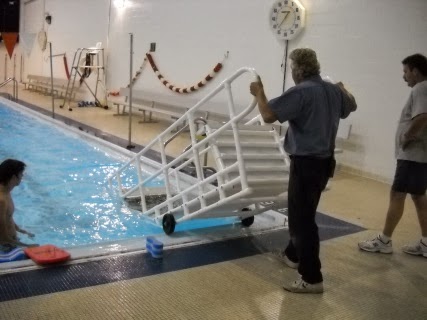
Instead you should be transferred into a lightweight pool chair and be ramped
into a pool, then floated off the chair with the help of a carer. This would
also benefit people who walk badly that find steps difficult, probably people
with sight issues would also find this type of access easier. I know it would
be very unsafe to try and put my severely brain damaged brother in a hoist as
he would not sit still, scream the place down, he loves the water, but as he
has got older his mobility has worsened meaning that he finds steps very
difficult. Swimming / water therapy for mobility restricted people should be
prescribed on a regular basis the long term health benefits are well documented
but largely ignored by community services up and down the country including
Peterborough. Gyms also fail to cater for wheelchair users that want to build
up their upper body strength, putting in pieces of kit that can only be
accessed via an inbuilt seat, rather than a removal one. They could also
provide Velcro straps and other aids that would make lifting small weights safe
for the disabled.
People
who organise festivals and special events. Some expect all wheelchair users to
be able to park on rough / sloped / gravel / grassed ground and still be able
to decamp from their wheelchair accessible cars and traverse to the event. It
even happened at the mobility show a couple a years ago when we went. Not
everyone is a Paralympian and do not have the strength to do that.
Cinemas
that insist on wheelchair users sitting at the front. No good for my husband
with all the metal work in his neck he can not lift his head that far for that
long.
There
are still a lot of barriers to going out in a wheelchair, that as an able bodied
person you would not necessarily think about.
Lessons to learn:
- Pools
should invest in removable ramps and light weight pool chairs.
- Gyms
to make as many pieces of equipment as possible accessible.
- People
that organise events should road test their facilities via a wheelchair.
- Cinema
owners should take out some seats at the end of some rows to accommodate
wheelchair users at various sitting positions in the cinema.
Access to Medical facilities.
Most
Doctors surgeries in Peterborough are for the most part accessible. Many do not
have a hoist available for couch examinations. Many consulting rooms are very
small with inadequate door widths for comfortable access. Waiting rooms sometimes
fail to make safe waiting areas available for wheelchair users, too many standard
chairs in the way. Also for those that can walk with difficulty, no higher
seats to make getting in and out of easier.
Dentists
& Opticians are for the most part inaccessible to visit. Even if you can
get through the door, the consulting rooms are full of immovable equipment
which make it impossible for the wheelchair user, unless can walk a little.
Hospitals
in Peterborough are pretty accessible as they are generally built to take
hospital beds in corridors etc. Many mistakes were made at PCH, some of which
have been resolved as building work has been completed. Still there are very
long corridors in PCH with quite a few inaccessible doors that create barriers to
the wheelchair user. Using diagnostic machines for x-rays etc is still an
absolute nightmare for the mobility impaired. The equipment being used is just
not transfer friendly.
NHS Wheelchair
services were transferred out to a company in Essex. This has been an utter disaster
from where we are sitting. They have such a huge area they can not possibly get
to know their clients. They seem to be utterly thrown by clients that have the
top level of specialised need. We have been trying to get a loan chair for over
three months now that I dare sit Husband in for any length of time so that his
oh so essential chair can be repaired. We have had drivers turn up without any
tools, without head rest, leg raisers, chair recliner etc. Next visit will be
the fifth attempt at getting it right so that we can get husbands chair fixed
of his horrible noisy recline mechanism which sounds like it is going to fail
at any moment. The cost of the petrol alone must be horrendous.
Private
Physiotherapists in Peterborough generally do not cater for people in
wheelchairs, some will do home visits. But at their premises no hoists. We used
to go to a business run out of a house that had recently gone through planning
permission that no one had said to them what about accessible access? We shamed
them into buying a temporary ramp so that we could get inside through the high
stepped door that is typical of domestic house builds. Inside all of the
physios we visited no hoists or wider couches which the disabled usually need.
Another just around the corner from us is in a relatively new business park,
where there is no disability designated parking and the entrance door is
impossible for an independent wheelchair user to use.
Lessons to learn:
1.
All
of these businesses whether private or NHS need to do the wheelchair test.
2.
Someone
at the council needs to enforce accessibility at the planning stage, for both
refurbishments and new builds.
3.
Peterborough
NHS needs to take back its wheelchair service.
Access to Housing.
Unfortunately
people who are unable to walk and totally reliant on a wheelchair will find
there are many barriers to finding somewhere to live. If you are lucky and your
incapacity comes when you own your own home, you will be able to apply for a
disability grant to help with making modifications to your home as long as you
don’t have over the prescribed limit in savings & income.
For those
without their own homes that rent to provide a roof over their heads you will
encounter several difficulties. Private landlords unwilling to provide secured
tenancies, and local councils / social landlords that will not take into
account your particular needs. You will be left with choices all extremely
unpalatable and in varying degrees unworkable.
Social Housing. You apply to join the local waiting Iist and if
you have a medical need will be assessed by a housing OT. This is where it
seems to go wrong, as the remit of the OTs seems to be to try and under remit
your disability as much as possible so that they can make you look like you are
being overly fussy about where you live. You will encounter phraseology such as,
“of course you will need to consider ground floor flats” , “you know we do not
have many bungalows in our stock”, etc etc. The approach is not to document
what you actually need but how much they think they can get away with. This has
led to me seeing disabled people all around me in places that I know they, family
and their care workers must be struggling in. The council does not seem to
grasp the difference between someone that needs level 2 housing and level 3
wheelchair accessible housing. Also that within level 3 there is two further
categories, firstly the independent wheelchair user that is either living solo
or with family and secondly the dependant wheelchair user where the home is
also a place of work for care-workers. The latter needing the greater “out of
the box” thinking as standard wheelchair home will not necessarily work because
of the possible extra hygiene and medical requirements. Peterborough like many
councils up and down the UK is badly letting down it most vulnerable in this
respect.
Private Renting. If you are a dependant wheelchair user you will
be extremely lucky to find a private landlord that is willing to give you a
secure tenancy of five years plus so that you can apply for a disability grant
to make the changes you will need to make a safe accessible home. It is about time there was a requirement of multiple
property landlords that have 10+ properties to make the 1 in every 10
accessible to a wheelchair user.
New Builds. Planning departments should insist that large new
developments include an appropriate mix of all building types.
Extra Care / Care Homes / Nursing Homes. Much has been said in the press
lately about the problems people face with dementia. A horrible disease that
took my maternal grandmother many years ago. I have become increasing worried
lately for our older folk and disabled that do not have this disease as their
liberties are being taken away in the institutions above in the name of keeping
those with that disease safe. These institutions should be very wary of this,
it is very difficult to accommodate the very varied needs of those in these
housing options. I have also become increasingly aware that families are
putting their loved ones in extra care facilities because of the degree of independent
supported living it gives as a more socially palatable solution as opposed to
the guilt of putting loved ones in a care home and all the negative
associations that has. Even when this is not suitable because of advancing
dementia, lack of facilities to cater for complex medical problems and from
where I am sitting local councils are duplicitous in this. Every area needs to
have a mix of different facilities that cater for the different difficulties
people find in later life or when disability is involved. I personally do not
think Peterborough has got this balance right at present. People are being put
in places according to next on the list, emergency placements etc instead of
what is right for them and their condition.
Lessons to learn:
- Someone at the council needs to head
up a task force with social services and NHS continuing care people, looking at
who is on the housing list with what medical / disability needs. Then a plan
needs to be put in place as to what measures can be taken in conjunction with
those citizens to house them according to need and not what the council can get
away with. This would include the acquisition of a small amount of privately
owned bungalows to refurbish, new builds and existing Housing Association
properties.
- Someone needs to deter families from putting disabled
& elderly relatives inappropriately in extra care facilities. Checks need
to be made prior to move regarding accessibility, hoist availability, specialised
care worker availability.
- OTs at the council need more training in the
difference between someone needing independent level 3 wheelchair accessible
housing and those that need specialised dependant housing to house care-workers
as well as tenants.
- Private landlords need to be engaged
to try and persuade a number of them to cater for wheelchair applicants.
City Planners:
If I were
to write a school report about accessible planning in the City of Peterborough it
would say “could do better”. In all aspects of planning questions should be
asked as to how does my decision affect a wheelchair user? can a wheelchair
user access this business ? will this pavement surface I am signing off be
comfortable for a chair user to traverse? Should this business owner being
doing more to make this planning application more disability friendly ? Has the
business done the wheelchair access test ? Should this lift be big enough to
accommodate an ambulance trolley ? Can a wheelchair user get out to a position
of safety quickly and easily ? should this buildings ceiling be capable of
taking a ceiling hoist ? Is this public access room big enough to accommodate a
person in a wheelchair? Should this new small business be allowed to have their
business upstairs with no access? Etc etc….
So there
you have it some of the things Peterborough could do better to make
Peterborough a more inclusive city.